
Workflow automation is now a must for teams that want to cut busywork and move faster. These platforms help you automate repetitive tasks, stitch together apps, and keep data flowing without manual hand-offs. Below we compare two popular open-source options n8n vs. Node-RED so you can see how their features, pricing, hosting, and communities stack up. Read on to figure out which one matches your technical needs and operational goals, especially if you’re building systems to connect clients with drone pilots or streamline service bookings.
What Are Workflow Automation Tools and Why Choose Open Source Platforms?
Workflow automation tools let you model and run repeatable processes everything from data syncs and notifications to multi-step approvals—without relying on people to move the data around. Open-source platforms like n8n and Node-RED add extra advantages: you can customize behavior, avoid vendor lock-in, and tap into a community that contributes plugins and fixes.
That collaborative foundation is supported by research showing workflow technology is central to redesigning business processes and delivering automated implementations.
Workflow Automation: Business Process Optimization & Management
Modern enterprises face global competition, tight margins, and the need to launch new services quickly. To meet those challenges, organizations must continually rethink how they work and adapt their information systems to changing processes.
Workflow technology supports this through (i) business process modeling to capture workflows, (ii) process reengineering to improve them, and (iii) workflow automation to implement those designs in software. This paper offers a high-level overview of current workflow management methods and tools.
An overview of workflow management:
From process modeling to workflow automation infrastructure, D Georgakopoulos, 1995
Choosing open source gives you the freedom to tailor an automation stack to your data, security, and scaling needs. It also accelerates innovation because fixers and plugin authors from around the world can contribute improvements.
For marketplaces and services that match clients with drone pilots, these platforms can automate bookings, lead routing, notifications, and reporting freeing your team to focus on growth and safety instead of manual coordination.
How Do Workflow Automation Tools Improve Business Processes?
Automation tools boost efficiency by cutting out repetitive manual steps. When you automate tasks like data entry, file uploads, or report generation, you reduce errors and speed up cycle times. That lets people spend time on higher-value work.
They also centralize work and make collaboration easier: teams get clearer visibility into who’s responsible for what, which improves accountability and helps projects move forward faster.
What Benefits Do Open Source Automation Platforms Offer?
Open-source automation platforms are attractive for several reasons. First, they tend to be more cost-effective since there are no license fees so more budget can go to development or operations.
Second, customization is a major perk: you can extend or modify behavior to match exact business rules and integrations instead of forcing your processes to fit a closed product.
Finally, the community around open source tools provides documentation, plugins, and troubleshooting help that speeds up problem solving and feature adoption.
How Do n8n and Node-RED Compare in Features and Use Cases?
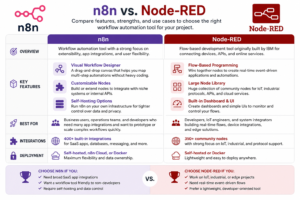
n8n vs. Node-RED each bring strengths that suit different projects. Below we break down their core capabilities and the scenarios where they shine so you can match tool to task.
What Are the Key Workflow Features of n8n?
n8n stands out for broad app connectivity and a workflow-first UI that lets non-developers build complex automations. Notable features include:
- Visual Workflow Designer: A drag-and-drop canvas that helps you map multi-step automations without heavy coding.
- Customizable Nodes: Build or extend nodes to integrate with niche systems or internal APIs.
- Self-Hosting Options: Run n8n on your own infrastructure for tighter control over data and privacy.
Those capabilities make n8n a good fit when you need many app integrations or want business users to prototype workflows quickly.
How Does Node-RED’s Visual Flow Editor Enhance Automation?
Node-RED is known for its straightforward flow-based editor and strong ties to IoT and edge use cases. Key strengths are:
- Flow-Based Programming: Compose flows by wiring nodes together, which gives a clear visual map of data paths and device interactions.
- Real-Time Editing: Edit and test flows live, which speeds up iteration and debugging.
- Wide Range of Nodes: A large ecosystem of pre-built nodes makes it fast to connect devices, APIs, and services.
Node-RED is especially well suited for projects that need device connectivity or real-time processing of streaming data.
What Are the Pricing and Hosting Options for n8n and Node-RED?
Price and deployment flexibility matter when you plan production automations. Both projects let you choose how and where you run them.
Can You Self-Host n8n and Node-RED?
Yes—both n8n and Node-RED support self-hosting. Running them on your servers or cloud accounts gives you control over environment configuration, compliance, and data residency.
- n8n: Provides clear docs for self-hosting and can be deployed on common cloud platforms or your own infrastructure.
- Node-RED: Installs on servers and edge devices alike, offering flexibility for both cloud and on-prem deployments.
Self-hosting is often the right choice for organizations with strict security or privacy requirements.
How Do Cloud and On-Premise Hosting Compare for These Platforms?
Deciding between cloud and on-premise comes down to trade-offs:
- Cloud Hosting: Easier scaling, lower maintenance, and faster updates—good when you want convenience and elasticity.
- On-Premise Hosting: Better for full control over data and compliance, though it usually requires more ops effort.
Match the hosting model to your operational constraints and compliance needs.
How Do Security and Scalability Differ Between n8n and Node-RED?
Security and ability to grow are essential for production workflows. Both platforms offer mechanisms to protect data and scale with demand.
What Security Features Does Each Platform Provide?
Security features help protect credentials, data in transit, and user access:
- n8n: Supports user authentication, role-based access controls, and encryption options for sensitive data.
- Node-RED: Supports secure authentication and can be run behind HTTPS and other infrastructure-level protections.
When evaluating either tool, consider how it will work with your identity provider, secrets management, and network security practices.
How Scalable Are n8n and Node-RED for Growing Workflows?
Both platforms are built to scale with the right architecture:
- n8n: Designed for horizontal scaling—add instances or workers to handle higher loads.
- Node-RED: Can be scaled by deploying multiple runtime instances and distributing flows across nodes.
Your scaling approach will depend on workflow complexity, concurrency needs, and how you manage state and queues.
What Community and Support Ecosystems Surround n8n and Node-RED?
A strong community and solid docs shorten the learning curve and help you resolve issues faster. Both projects benefit from active user bases.
How Active Are the n8n and Node-RED Open Source Communities?
Both communities are active and produce useful resources:
- n8n: A growing community contributing integrations, guides, and troubleshooting help.
- Node-RED: A long-established ecosystem with many community nodes, tutorials, and real-world examples.
Community activity is a good indicator of how quickly you’ll find help or new integrations when you need them.
What Support Resources Are Available for Each Platform?
Beyond community forums, both projects offer documentation and learning materials:
- n8n: Detailed docs, tutorials, and an active forum for questions and feature requests.
- Node-RED: Comprehensive documentation, user forums, and many community-contributed tutorials and nodes.
Combine these resources with your internal expertise to get the most from either platform.
Which Use Cases Best Suit n8n vs. Node-RED for Your Automation Needs?
Choosing the right tool comes down to the problem you’re solving. Below are common scenarios where each platform excels.
What Industries and Scenarios Favor n8n’s Extensibility?
n8n’s strength in integrations and workflow logic makes it a good choice for:
- E-commerce: Automating order workflows, inventory updates, and customer notifications.
- Marketing: Connecting CRMs, email platforms, and analytics for automated campaigns.
- Finance: Streamlining data collection and reporting tasks.
If you need broad app connectivity and business-user-friendly flows, n8n is a solid option.
How Does Node-RED Excel in IoT and Flow-Based Programming?
Node-RED shines where device connectivity and real-time data matter:
- Smart Home Automation: Coordinating sensors and actuators for seamless control.
- Industrial Automation: Monitoring and controlling equipment with low-latency flows.
- Data Visualization: Building dashboards that display IoT telemetry for quick decisions.
For projects that require real-time device integration and edge deployments, Node-RED is often the preferred choice.
Read More Related – n8n vs Traditional Integration Platforms
Conclusion
n8n and Node-RED both offer powerful, flexible options for automating workflows each with different strengths. n8n excels at broad integrations and business-focused automations, while Node-RED is ideal for device-oriented and real-time flows. Consider your integration needs, hosting and security requirements, and which community and tooling best support your team. If you’re building automation around drone services booking, lead routing, and notifications either platform can be effective when matched to the right use case. Dive into our comparison resources and try small proof-of-concept flows to see which tool feels right for your stack.