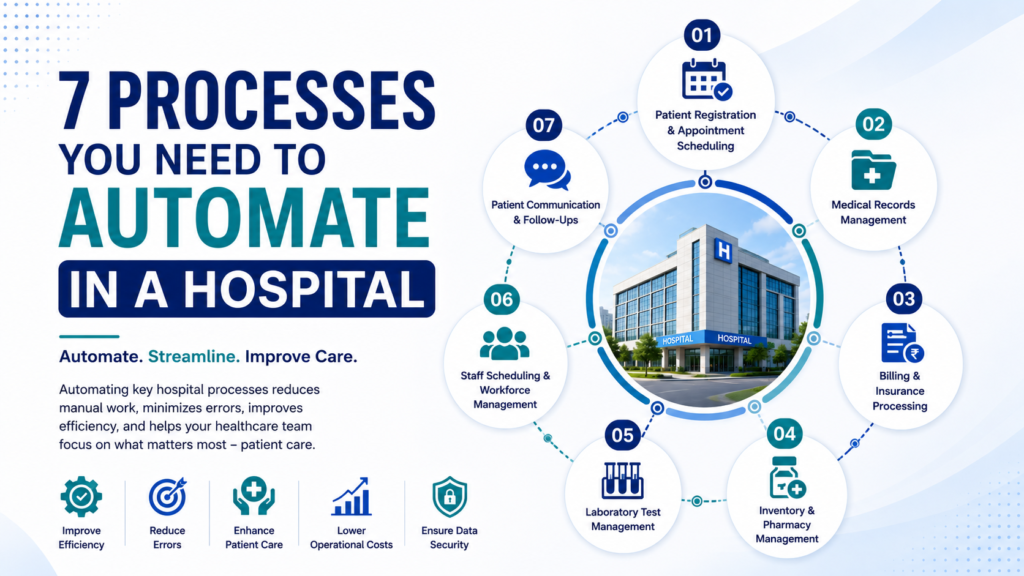
7 Processes You Need to Automate in a Hospital
Running a hospital is not a simple job. Every single day, hundreds of patients walk in some for routine check-ups, some for emergencies, some for planned surgeries. Each patient needs…

Explore our blog for the latest trends, tips, tutorials and technologies that are shaping the future of software development.
Running a hospital is not a simple job. Every single day, hundreds of patients walk in some for routine check-ups, some for emergencies, some for planned surgeries. Each patient needs…

Marketing automation has evolved rapidly over the past few years. Businesses no longer rely only on simple email sequences or CRM workflows. Today, organizations are building intelligent automation systems powered…

For decades, manufacturing automation was synonymous with machines—robotic arms, conveyor belts, and programmable logic controllers (PLCs). Automation meant speed, consistency, and reduced labor costs. But today, AI automation in manufacturing…

Introduction: Why No-Code AI Automation Matters in 2026 In 2026, the biggest advantage businesses have is not hiring more people or adding more tools.It’s removing friction from everyday work. Teams…

A chatbot built with OpenAI and Retrieval-Augmented Generation (RAG) delivers accurate, context-aware answers by combining large language models with private or real-time knowledge sources. Unlike traditional chatbots, RAG-based systems reduce…

Introduction: The Customer Support Shift in 2025 Customer expectations have changed dramatically in the last decade, but 2025 marks a turning point unlike any we’ve seen before. With generative AI…

Artificial Intelligence (AI) has come a long way from simple tools that follow instructions to intelligent systems that can actually think and act on their own. Over the last few…
Workflow automation is transforming how businesses operate. It streamlines processes, reduces errors, and boosts efficiency. In today's fast-paced world, staying competitive means embracing automation. Businesses are increasingly turning to workflow automation to gain an edge. The technology is evolving rapidly. New trends are emerging that promise to reshape the landscape of business automation. AI and machine learning are at the forefront of this evolution. They enhance decision-making and optimize workflows. Cloud-based solutions offer scalability and flexibility. They are becoming the preferred choice for many organizations. Robotic Process Automation (RPA) is another key player. It automates repetitive tasks, freeing up human resources for strategic activities. Security and compliance are crucial in automated workflows. Ensuring data protection and regulatory adherence is a top priority. As we look to the future, understanding these trends is essential. Businesses must prepare for the next wave of workflow automation. The Evolution of Workflow Automation Workflow automation has come a long way. From simple task management to complex business process automation, its journey is remarkable. In the early days, workflow automation focused on basic task digitization. Email notifications and document sharing were revolutionary. Over time, the integration with software tools became crucial. Businesses began using automation software to streamline operations. Today, workflow automation embraces advanced technologies. AI, machine learning, and RPA play significant roles in modern workflow systems. Notable milestones include: Email Automation: Simplified communication. Integration with ERP Systems: Enhanced data management. Introduction of RPA: Automated repetitive tasks. AI and ML Integration: Improved decision-making. The future holds even more promising developments. Automation is no longer just about efficiency; it's about intelligence. Workflow automation is now at the heart of digital transformation. It helps businesses respond swiftly to market changes and customer demands. Modern systems offer personalization and customization. They cater to unique business needs, providing tailored solutions. The evolution is driven by the need for agility and precision. Businesses must adapt to remain relevant in an increasingly automated world. Key Drivers of Workflow Automation Adoption The adoption of workflow automation is accelerating. Businesses are recognizing its potential for transformation and efficiency. Several key factors drive this trend. The need for cost reduction and process optimization stands out. Automation reduces manual work, cutting expenses significantly. Efficiency is also a major motivator. Automated workflows enhance productivity and minimize errors. They enable faster and more accurate task completion. Additionally, competition pushes businesses toward automation. Companies leveraging technology gain an edge in the market. Automation helps them deliver better services swiftly. Adaptability to change is crucial in today's fast-paced world. Automation enables quick adjustments to new opportunities or challenges.…

Insurance companies face mounting pressure to deliver faster claims processing, more accurate underwriting, and round-the-clock customer service all while managing costs and regulatory compliance. Traditional automation has helped, but it's…

Behavioral health providers are facing immense pressure. Rising demand for services, coupled with persistent staff shortages and complex compliance requirements, has created a challenging environment. Clinicians and administrative staff often…