
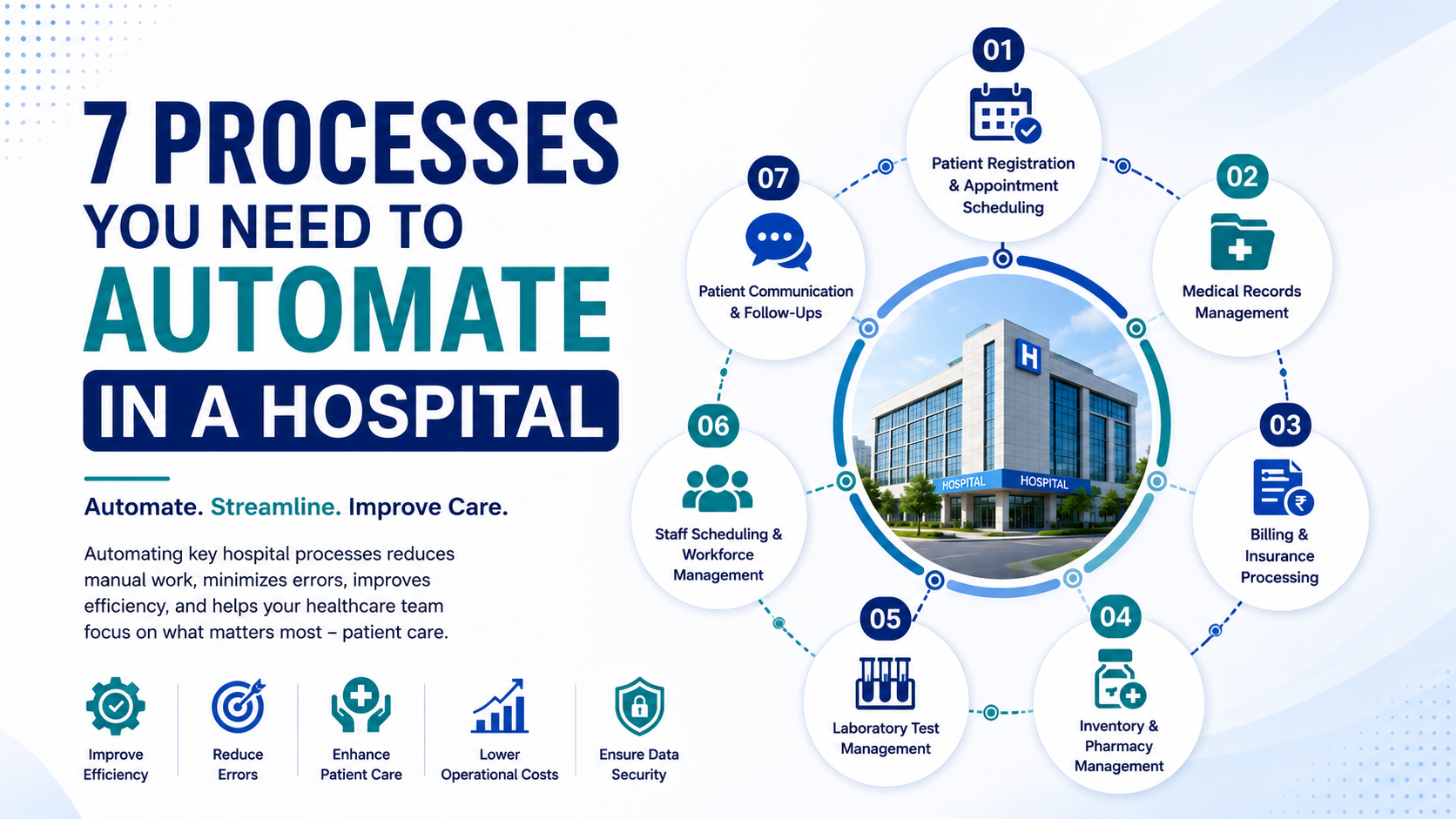
Running a hospital is not a simple job.
Every single day, hundreds of patients walk in some for routine check-ups, some for emergencies, some for planned surgeries. Each patient needs to be registered, assigned to the right doctor, given the correct medicines, billed accurately, and discharged properly. And behind every one of these steps, there is paperwork, there are approvals, and there is someone manually entering data into a system.
Now multiply this by 500 patients a day. The workload becomes enormous very quickly.
It is no surprise that hospital staff feel constantly overwhelmed. Doctors spend more time filling forms than actually talking to patients. Nurses run between departments carrying files. Billing teams work late reconciling insurance claims. And somewhere in all this, mistakes happen mistakes that cost money, damage the hospital’s reputation, and sometimes directly affect patient safety.
Here is the thing though most of this chaos is completely avoidable.
Hospital process automation can take all the repetitive, rule-based tasks off your team’s plate and handle them automatically faster, more accurately, and without human error.
In this blog, we will walk you through the 7 most important hospital processes you should automate, what the problem looks like today, and exactly how automation makes it better.
What Is Hospital Process Automation?
Hospital process automation simply means using software to handle the routine administrative tasks that your staff is currently doing manually.
Instead of a nurse physically carrying a file from one department to another, the system routes it automatically. Instead of a billing executive manually entering procedure codes one by one, the system picks them up directly from the patient’s medical record. Instead of a manager calling multiple people to fill a vacant shift, the system sends out notifications and confirms the replacement on its own.
Modern hospital automation tools connect with your existing systems your Hospital Management System, Electronic Health Records software, billing platform, and HR tools so that information flows smoothly across all departments without anyone having to move it by hand.
The goal is not to replace the doctors or nurses. The goal is simply to remove the administrative burden that is eating into their time and energy every single day.
Why Hospitals Need Workflow Automation
Before we get into the specific processes, it helps to understand how big this problem actually is.
- Administrative tasks account for nearly 25 to 30 percent of total hospital operating costs across most healthcare systems.
- On average, physicians spend 4 to 6 hours every day on documentation and data entry time that could be spent with patients instead.
- A large share of insurance claim rejections happen simply because of incorrect or incomplete documentation something automation can largely prevent.
- Staff burnout, which is a serious problem in healthcare, is heavily driven by repetitive manual work that adds no clinical value.
Automation addresses every single one of these issues. Let us now look at exactly where it makes the biggest difference.
1. Patient Admissions and Discharge
The Problem Today
The admissions counter is the very first experience a patient has of your hospital. And in most hospitals, it is not a good one.
Patients wait in long queues while staff frantically type into computers, pass paper forms around, and make phone calls trying to find out which beds are available. Information gets entered once on paper and then again into the system. If a detail is missed say, a known allergy or an important prior diagnosis it may not be caught until much later.
Discharge is equally frustrating. Even after the doctor has cleared a patient, families often wait for hours while paperwork travels through multiple departments for approval. Beds stay occupied longer than needed, and patient satisfaction takes a hit.
What Automation Does
When the admissions and discharge process is automated:
- The moment a patient is registered, the system automatically notifies the relevant ward, pharmacy, and billing team no manual coordination is needed.
- Bed assignment happens digitally in real time, based on availability and the patient’s care requirements.
- Pre-admission forms insurance details, consent documents, medical history are collected electronically in advance, so patients do not have to fill lengthy forms when they arrive.
- At discharge, the system automatically generates a checklist and sends it to the doctor, nurse, and billing team at the same time, so everyone works in parallel instead of one after the other.
The outcome is faster patient flow, shorter waiting times, and a much lighter workload for your admissions staff.
2. Appointment Scheduling and Reminders
The Problem Today
How many calls does your front desk handle in a day just for appointments? And out of all those bookings, how many patients actually show up?
Missed appointments commonly called no-shows are a serious problem for hospitals everywhere. A patient books a slot two weeks in advance and then simply forgets to come. That slot is now wasted. The doctor’s time is lost. And another patient who needed that appointment could not get one.
Manual scheduling only makes this worse. Appointment books and spreadsheets do not integrate with clinical systems, which leads to double bookings, rescheduling confusion, and a huge amount of phone traffic that could easily be automated.
What Automation Does
An automated scheduling system can:
- Allow patients to book, reschedule, or cancel appointments online through your website or app at any time of day, without calling the front desk.
- Send automatic appointment reminders via SMS or email one day before and a few hours before the visit. This single feature alone brings down no-show rates significantly.
- Free up cancelled slots instantly so other patients can book them without any manual intervention.
- After the appointment, automatically send follow-up messages prescription reminders, next visit dates, or post-procedure care instructions.
Your front desk team stops spending their day on the phone and starts focusing on things that actually need their attention.

3. Medical Billing and Insurance Claims
The Problem Today
Medical billing has become increasingly complex. Between procedure codes, diagnosis codes, insurance documentation requirements, and government health scheme guidelines, there is a lot that can go wrong.
When billing is done manually, errors creep in at every step. Codes get entered incorrectly. Documents go missing. Claims are submitted with incomplete information and get rejected. Then someone has to manually review the rejection, find the error, fix it, and resubmit sometimes weeks later.
Each rejected claim delays cash flow and costs the billing team time that could be better spent elsewhere. According to the American Medical Association, nearly 1 in 4 medical claims is rejected on first submission and the majority of those rejections are due to errors that automation can prevent.
What Automation Does
An automated billing workflow can:
- Pull billing codes directly from the patient’s clinical records, eliminating manual entry and the errors that come with it.
- Verify insurance eligibility in real time before treatment begins, so coverage gaps are identified before they become billing problems.
- Submit claims automatically with all required documentation attached, and track their status flagging only the exceptions for a human to review.
- Send payment reminders automatically to patients with outstanding dues, improving collections without your team needing to make follow-up calls.
The result is a faster reimbursement cycle, fewer claim rejections, and a billing team that finally has time to do meaningful work.
4. Staff Scheduling and Shift Management
The Problem Today
Building a duty roster for a large hospital is genuinely one of the hardest administrative tasks in healthcare operations.
You need to account for different skill sets across departments, leave requests, weekly offs, seniority rules, maximum working hours, and unexpected absences. And this needs to be done every single week, sometimes more frequently.
Most hospitals still manage this with spreadsheets or paper registers. When someone calls in sick early in the morning, there is a scramble to find a replacement. When the roster is poorly planned, some wards end up understaffed while others have more people than needed.
Understaffing is not just an operational inconvenience. It is a patient safety risk.
What Automation Does
A staff scheduling automation tool can:
- Generate optimised rosters automatically based on your defined rules ward requirements, staff qualifications, shift limits, and preferences.
- Route leave requests through a digital approval workflow, automatically updating the schedule when leave is approved.
- Send instant alerts when a shift is at risk due to an absence, and notify eligible staff to check availability no frantic calling needed.
- Track working hours, overtime, and attendance in real time, making payroll simpler and more accurate.
When scheduling is automated, managers stop spending hours building rosters manually. Staff experience a fairer, more transparent system. And the hospital maintains safe staffing levels with far less effort.
5. Inventory and Supply Chain Management
The Problem Today
Ask any hospital administrator about inventory and you will hear one of two complaints either critical supplies keep running out, or there is too much stock expiring in the storeroom. Often, both problems exist at the same time in different departments.
Manual inventory management simply cannot keep pace with the speed at which a hospital consumes supplies. By the time someone notices a shortage, raises a purchase request, gets it approved, and places the order, the supplies may already be critically low. On the other side, overstocking medicines and consumables wastes budget on items that expire before they are used.
What Automation Does
An automated inventory system can:
- Monitor stock levels continuously and automatically raise purchase orders when items fall below the minimum threshold without anyone having to check manually.
- Route purchase approvals digitally, cutting down the time from raising a request to placing an order from days to just hours.
- Track expiry dates for medicines and consumables, sending alerts well before items expire so they can be used in time or returned.
- Integrate with the operation theatre and procedure schedules so the system can anticipate upcoming supply needs and ensure stock is ready in advance.
This shift from reactive to proactive supply management reduces waste, prevents shortages, and takes a significant load off your stores and procurement teams.
6. Compliance and Staff Credentialing
The Problem Today
Hospitals operate in one of the most heavily regulated industries in the world. There are accreditation standards to maintain, licensing requirements to meet, and certifications for every clinical staff member to keep current. Tracking all of this manually usually across spreadsheets and physical registers is both time-consuming and unreliable.
A certificate expires without anyone noticing. An accreditation audit is due and the documentation is scattered. A newly joined doctor starts seeing patients before their credentials have been fully verified.
These are not hypothetical situations. They happen regularly, and the consequences regulatory penalties, accreditation issues, and liability risks are serious.
What Automation Does
An automated compliance and credentialing workflow can:
- Track expiry dates for all licenses and certifications across your entire clinical workforce, and send automated renewal reminders well in advance.
- Put new staff through a structured digital credentialing workflow document submission, verification, and approval before any clinical privileges are granted.
- Generate compliance reports automatically for internal audits and external inspections, so your team is never scrambling to pull together documentation last minute.
- Send real-time alerts when a compliance deadline is approaching or a policy deviation is detected.
When compliance is automated, your HR and quality teams stop firefighting and start managing risk proactively. And your hospital remains audit-ready at all times.
7. Patient Feedback and Complaint Management
The Problem Today
Patient experience matters more than ever today. With online reviews and social media playing a big role in how people choose hospitals, a single unresolved complaint can do real damage to your reputation.
Yet most hospitals still collect patient feedback through paper forms near the exit that no one reads regularly. Complaints come in through phone calls, get logged somewhere informally, and then drift through departments with no clear ownership or timeline for resolution.
There is no tracking, no accountability, and no way to identify patterns like if patients from a particular ward are consistently unhappy about something that could easily be fixed.
What Automation Does
An automated patient feedback system can:
- Trigger a feedback message automatically via SMS or email after every discharge, while the patient’s experience is still fresh.
- Route complaints immediately to the relevant department head with clear ownership and a defined deadline for resolution.
- Escalate automatically if a complaint is not addressed within a set timeframe so nothing slips through the cracks.
- Generate periodic reports showing satisfaction trends by department or ward, giving hospital leadership the data they need to make real, targeted improvements.
When feedback is managed systematically, patients feel heard, problems get resolved faster, and your hospital builds a reputation that keeps patients coming back.
Summary: What Automation Delivers
When all seven of these processes are automated, the combined impact on a hospital is significant.
| Hospital Process | Key Benefit |
|---|---|
| Patient Admissions & Discharge | Shorter wait times, smoother patient flow |
| Appointment Scheduling | Fewer no-shows, less front desk workload |
| Medical Billing & Claims | Fewer rejections, faster reimbursements |
| Staff Scheduling | Safer staffing levels, less manual roster work |
| Inventory & Supply Chain | No stockouts, reduced expiry waste |
| Compliance & Credentialing | Always audit-ready, no missed renewals |
| Patient Feedback | Faster resolution, better patient satisfaction |
And across all seven, the bigger benefit is the same your clinical staff get more time for patients, your administrative team stops doing repetitive work, and your hospital operates more efficiently with fewer costly errors.
How to Get Started
If you are ready to begin, here is a straightforward approach:
Step 1 – Identify your biggest pain point. Which process is causing the most delays, the most errors, or the most complaints from staff right now? Start there. Do not try to automate everything at once.
Step 2 – Map the process as it works today. Write down every step, every person involved, and every decision point. You need to understand the current process clearly before you can automate it well.
Step 3 – Choose the right platform. Look for automation software that integrates properly with your Hospital Management System or EHR. Integration is everything automation that still requires manual data transfer between systems is not really automation.
Step 4 – Pilot in one department first. Before rolling out hospital-wide, run a pilot in one area. This helps you catch issues early and builds confidence among staff and management.
Step 5 – Measure the results. Track how things improve time saved, errors reduced, staff hours freed up. Use this data to make the case for expanding automation further.
Conclusion
Hospitals do incredibly important work. But too much of the burden on hospital staff does not come from the complexity of medical care itself it comes from outdated, manual administrative processes that were never designed for the scale of modern healthcare.
Automating these seven processes admissions, scheduling, billing, staff management, inventory, compliance, and patient feedback will not transform your hospital overnight. But it will steadily remove the friction that slows your team down every single day, frees them up for the work that actually matters, and helps you deliver better care to every patient who walks through your doors.
The technology is available. The benefits are proven. All that is left is to get started.
Read Related Blog –Workflow Automation for Behavioral Health: The 2025 Guide